
Can PVA Fibers Replace Steel in HPC Applications?

Updated: Aug 20
Information Tags
• Type: 4-minute read
• Audience: Construction professionals, engineers, architects, contractors
Abstract
Explore whether PVA fibers can replace steel in HPC applications by examining their mechanical performance, crack control capabilities, and compatibility with high-performance concrete. This article evaluates the potential of fiber reinforcement as a partial or full alternative to traditional steel rebar.

Find the perfect solution for your concrete project. [Explore solutions]
The Role of Reinforcement in High-Performance Concrete (HPC)
High-Performance Concrete (HPC) is known for its superior strength, durability, and reduced permeability compared to conventional concrete. However, like all brittle materials, HPC is prone to cracking under tensile stress — making reinforcement essential for structural integrity.
Traditionally, steel rebar has been the go-to solution for reinforcing concrete structures. But with growing interest in lightweight, corrosion-resistant, and more sustainable construction methods, many professionals are asking: can PVA fibers replace steel in HPC applications?
The short answer is not entirely — but in many cases, PVA fibers can significantly reduce reliance on steel, especially in specific design contexts.
Understanding How PVA Fibers Perform in HPC
1. Mechanical Properties of PVA Fibers
Polyvinyl Alcohol (PVA) fibers are engineered specifically for use in cementitious systems. They offer:
Tensile Strength: ~1,600 MPa
Modulus of Elasticity: ~30–40 GPa
Elongation at Break: ~6%
Bonding Behavior: Excellent due to micro-scale fibrillation under stress
Alkali Resistance: Very high, ensuring long-term durability in concrete environments
These characteristics make PVA fibers highly effective at improving post-cracking performance, ductility, and energy absorption in HPC.
Comparing PVA Fibers and Steel Reinforcement
Property | PVA Fiber | Steel Rebar |
Tensile Strength | High (~1,600 MPa) | Very High (~500–2,000 MPa) |
Bond with Cement Matrix | Excellent | Strong (dependent on surface texture) |
Corrosion Resistance | Exceptional | Poor without protection |
Weight | Very Light | Heavy |
Crack Control | Excellent in early and post-crack stages | Effective only after cracks form |
Fire Resistance | Moderate | Good |
Ease of Placement | Easy – no alignment required | Labor-intensive installation |
Sustainability | Non-metallic, recyclable | Energy-intensive production |
From this comparison, it's clear that while PVA fibers cannot fully replace steel in HPC applications, they can serve as an effective supplementary or even primary reinforcement method in certain scenarios — particularly where corrosion resistance, weight reduction, and improved crack control are priorities.
When Can PVA Fibers Be Used Instead of Steel?
1. Thin Structural Elements
In architectural façades, cladding panels, and thin-shell structures, PVA fibers provide sufficient reinforcement to eliminate or drastically reduce the need for steel mesh or rebar.
2. Ultra-High Performance Concrete (UHPC)
UHPC typically uses PVA fibers as the main reinforcement mechanism. These elements achieve compressive strengths over 150 MPa and exhibit strain-hardening behavior — allowing them to carry loads even after initial cracking.
3. Corrosion-Sensitive Environments
In marine structures, wastewater treatment plants, and bridge decks exposed to deicing salts, steel corrosion is a major concern. In such cases, PVA fibers can replace steel in HPC applications to extend service life and reduce maintenance costs.
4. Prefabricated and Modular Construction
For precast elements where rapid assembly and light weight are critical, replacing some steel with PVA fibers can streamline production and improve handling efficiency.
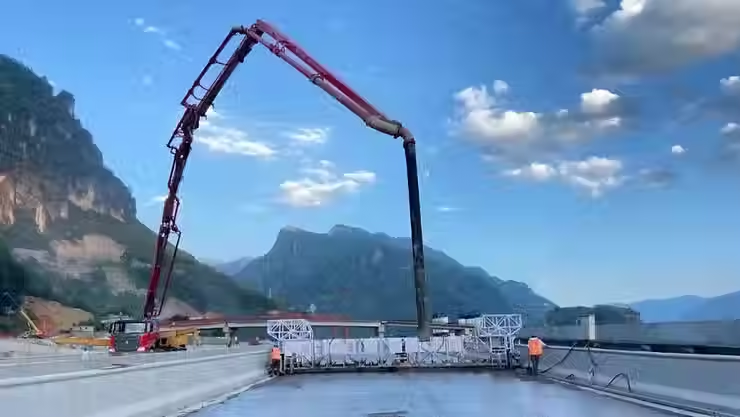
See how we’ve helped projects around the world succeed. [View projects]
Limitations and Considerations
Despite their advantages, PVA fibers cannot completely replace steel in HPC applications that require large-scale load-bearing capacity, such as:
Deep beams and columns
Foundations and retaining walls
Structures subject to extreme dynamic or seismic forces
In these cases, hybrid reinforcement strategies — combining PVA fibers with minimal steel — often deliver the best balance between performance, cost, and longevity.
Supporting Sustainable Construction with PVA Fiber Technology
One of the most compelling reasons to consider whether PVA fibers can replace steel in HPC applications lies in sustainability:
Reduced embodied carbon from lower steel content
Extended service life due to superior crack resistance
Lower maintenance needs thanks to corrosion resistance
Lighter structures requiring less material and transportation energy
By integrating PVA fibers into HPC designs, engineers can create more resilient and eco-friendly infrastructure — without compromising safety or performance.
Pioneer Fibre: Advancing Fiber Solutions for High-Performance Concrete
At Pioneer Fibre, we specialize in advanced fiber technologies designed to meet the evolving demands of modern construction. Our PIONEER® PVA Fiber line is specifically formulated for optimal performance in HPC and UHPC applications, offering unmatched durability, bond strength, and workability.
We collaborate closely with architects, engineers, and contractors to determine when PVA fibers can replace steel in HPC applications — and how to optimize fiber dosage and mix design for maximum effectiveness.
Whether you're designing a corrosion-resistant bridge deck, a lightweight façade system, or a modular building component, our team provides the technical support and product validation needed to make informed decisions.
Explore PIONEER’s range of concrete reinforcement fibers and how they improve concrete properties. Visit our website: www.pioneerfibre.com
Micro fiber >> Learn More
Macro fiber >> Learn More
Steel fiber >> Learn More
Asphalt fiber >> Learn More
Looking for a tailored fiber or concrete reinforcement solution?
Our technical team supports mix design optimization, material selection,and project-specific recommendations worldwide.


Comments