
Engineering Extreme Durability with Corrosion Resistant Concrete Reinforcement

The structural longevity of civil infrastructure is heavily dependent on the environmental durability of its reinforcing elements. For decades, steel rebar and welded wire mesh have been the industry defaults. However, in aggressive chemical environments—such as chemical manufacturing facilities, coastal marine installations, agricultural wastewater tanks, and mining shafts—steel faces rapid degradation.
When moisture, salt ions, or acids penetrate concrete's naturally porous matrix, they cause conventional steel to rust and expand. This expansion fractures the concrete from within, causing severe spalling. Shifting to advanced materials like Rimix 3D provides a highly reliable, corrosion resistant concrete reinforcement option that remains fully inert under aggressive chemical exposure.
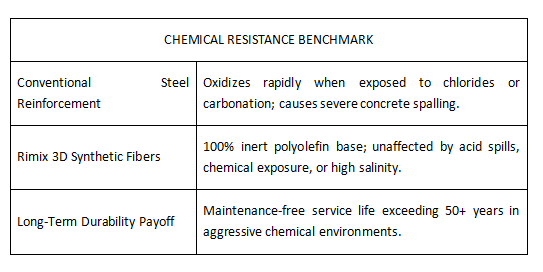

To understand why Rimix 3D provides premium corrosion resistant concrete reinforcement, we must examine its chemical composition. Rimix 3D is manufactured from a high-grade, virgin polyolefin synthetic copolymer consisting of saturated hydrocarbon chains.
Unlike metallic materials, this polymer base does not contain iron atoms, making the electrochemical oxidation process of rust scientifically impossible. The material remains unaffected by water molecules, dissolved oxygen, or high chloride ions.
Saltwater/Acid Spill Ingress ---> Penetrates Concrete Capillary Pores
|- Steel Mesh Wire ----> Triggers Iron Electrochemical Oxidation ----> Structural Rust/Spalling
|- Rimix 3D Polyolefin ----> Zero Free Ions / Saturated Bonds ----> Sustained Structural Stability
Withstanding High Alkalinity with Corrosion Resistant Concrete Reinforcement
The interior of fresh concrete is a harsh chemical environment. Due to the presence of calcium hydroxide, the internal pore fluid is highly alkaline, with pH values typically ranging from 12.5 to 13.5. Certain fiber alternatives, such as standard E-glass fibers, degrade rapidly under this continuous alkaline exposure, losing their structural capacity over time.
Rimix 3D's specific copolymer formulation provides excellent alkali resistance, ensuring the fibers maintain their full tensile performance over decades of contact with cement paste.
In heavy industrial facilities, concrete structures are frequently exposed to aggressive acidic compounds. These include lactic and acetic acids in food processing plants, sulfuric acid in industrial mining operations, and organic acids within agricultural silage silos. Acid exposure breaks down the protective calcium silicate hydrate matrix of the concrete, allowing rapid chemical ingress.


Eliminating Concrete Spalling Risk
When traditional steel fibers rust near the surface of an industrial floor, they expand and pop out, creating micro-pitted surfaces that accumulate dirt and compromise facility hygiene.
By utilizing Rimix 3D corrosion resistant concrete reinforcement, any fibers exposed at saw-cut joints or on the slab surface remain entirely unaffected by washdowns, chemical spills, or aggressive cleaning agents. This durability preserves a flat, smooth floor finish, helping industrial assets pass strict health, safety, and environmental audits.


Comments