
Enhancing Tunnel Segment Durability with PVA Fiber-Reinforced UHPC

Updated: Aug 25
Information Tags
• Type: 4-minute read
• Audience: Construction professionals, engineers, architects, contractors
Abstract
Tunnel segments are subjected to extreme mechanical and environmental stresses. This article explores how enhancing tunnel segment durability with PVA fiber-reinforced UHPC delivers superior strength, crack resistance, and long-term performance — making it a preferred solution for modern underground infrastructure.
Find the perfect solution for your concrete project. [Explore solutions]
The Challenge of Tunnel Segment Longevity
Tunnel construction is one of the most demanding fields in civil engineering. Tunnel segments must endure:
High compressive and shear loads
Ground movement and settlement
Water pressure and seepage
Chemical exposure
Seismic activity
Traditional concrete formulations often struggle to meet these challenges without significant maintenance over time. As a result, engineers and contractors are increasingly turning to advanced materials like UHPC (Ultra-High Performance Concrete) enhanced with **PVA (Polyvinyl Alcohol) fibers to ensure structural integrity and service life that exceed expectations.
Why Tunnel Segments Need Better Materials
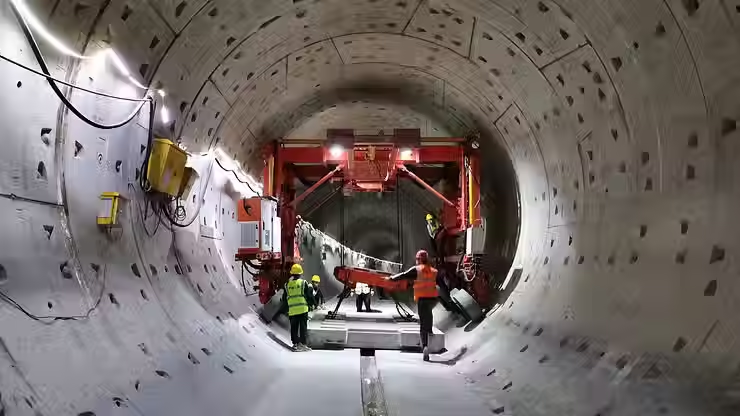
Precast tunnel segments form the primary lining of shield-driven tunnels used in metro systems, roadways, and utility conduits. Their performance directly impacts:
Safety and operational reliability
Maintenance frequency and cost
Life-cycle value of the entire structure
By incorporating PVA fiber-reinforced UHPC, tunnel designers can achieve unprecedented levels of durability, resilience, and sustainability.

What Is PVA Fiber-Reinforced UHPC?
UHPC is a high-performance cementitious composite known for its:
Compressive strength exceeding 150 MPa
Low porosity and permeability
Exceptional resistance to aggressive environments
When combined with PVA fibers, which are alkali-resistant, hydrophilic, and mechanically robust, UHPC gains critical advantages:
Key Benefits of PVA Fibers in UHPC Tunnel Segments
Improved Flexural Strength: Even after initial cracking, PVA fibers maintain load-carrying capacity.
Superior Crack Control: Microcracks are bridged effectively, preventing water ingress and corrosion.
Reduced Permeability: Lower chloride ion penetration extends service life.
Enhanced Impact Resistance: Ideal for seismic zones or blast-prone environments.
Corrosion-Free Reinforcement: Unlike steel fibers, PVA fibers do not rust, ensuring long-term performance.
These properties make PVA fiber-reinforced UHPC an ideal candidate for tunnel segments where safety, longevity, and minimal maintenance are crucial.
Real-World Applications: Where PVA Fiber-Reinforced UHPC Is Making an Impact
Several major infrastructure projects have adopted PVA fiber-reinforced UHPC in tunnel segments — demonstrating both technical feasibility and economic benefits.
1. Copenhagen Metro Extension – Denmark
Engineers specified PVA fiber-reinforced UHPC for precast tunnel rings due to its high impermeability and low shrinkage. The result was significantly reduced maintenance planning and extended design life beyond 100 years.
2. Crossrail Project – United Kingdom
For underwater sections of the rail link beneath the Thames River, UHPC with PVA fibers was used to enhance watertightness and structural resilience against dynamic loading conditions.
3. Tokyo Underground Utility Tunnels – Japan
With rising concerns about seismic vulnerability, Japanese authorities have mandated the use of PVA fiber-reinforced UHPC in new underground utility corridors — leveraging its energy absorption capabilities during earthquakes.
These examples illustrate how enhancing tunnel segment durability with PVA fiber-reinforced UHPC is not just theoretical but actively shaping global tunneling standards.
Design Considerations for Implementing PVA Fiber-Reinforced UHPC
Successfully integrating PVA fibers into UHPC tunnel segments requires attention to several key factors:
1. Fiber Dosage and Geometry
Typical dosage ranges from 1% to 3% by volume. Shorter, finer fibers improve microcrack control, while longer fibers enhance post-cracking ductility.
2. Mixing and Dispersion Techniques
Uniform distribution is critical. Advanced mixing protocols, including dry blending followed by wet dispersion, help avoid fiber clumping and ensure consistent performance.
3. Curing Regimes
UHPC typically undergoes heat treatment (autoclaving or steam curing) to accelerate hydration. PVA fibers remain stable under moderate thermal curing conditions, making them compatible with standard precasting practices.
4. Structural and Serviceability Analysis
Designers should account for fiber contributions to flexural toughness and residual strength when modeling behavior under service and ultimate limit states.
5. Code Compliance and Testing
While traditional reinforcement codes may not fully address fiber-enhanced UHPC, international standards such as fib Model Code 2010 and EN 14651 offer guidance on assessing performance and safety.
A Smarter Approach to Tunnel Segment Manufacturing
The adoption of PVA fiber-reinforced UHPC is not only improving tunnel performance — it’s also transforming how segments are manufactured and installed:
1. Faster Production Cycles
With optimized mix designs and curing methods, manufacturers can achieve early-age strength more quickly — accelerating production and reducing lead times.
2. Reduced Steel Reinforcement
In many cases, PVA fibers can replace or supplement conventional rebar or welded mesh — simplifying fabrication and lowering material costs.
3. Cleaner, More Sustainable Construction
The reduced need for repairs, lower carbon footprint of thinner sections, and long service life align with global sustainability goals and ESG reporting requirements.
Redefining Tunneling Standards Through Innovation
As underground construction expands to accommodate growing urban populations and climate-resilient infrastructure needs, the demand for durable, high-performance materials will continue to rise.
Enhancing tunnel segment durability with PVA fiber-reinforced UHPC represents a major step forward — combining cutting-edge material science with practical engineering solutions to build safer, smarter, and more sustainable tunnels.
For engineers, contractors, and materials suppliers, understanding and adopting this technology is essential for staying competitive in a rapidly evolving market.
Explore PIONEER’s range of concrete reinforcement fibers and how they improve concrete properties. Visit our website: www.pioneerfibre.com
Micro fiber >> Learn More
Macro fiber >> Learn More
Steel fiber >> Learn More
Asphalt fiber >> Learn More
Looking for a tailored fiber or concrete reinforcement solution?
Our technical team supports mix design optimization, material selection,
and project-specific recommendations worldwide.


Comments