
The Engineering Mathematics Behind Macro Synthetic Fiber Dosage Equivalent to Steel Specifications

When a design team proposes substituting traditional steel fibers with advanced polyolefin structural polymers, the procurement department and the chief structural engineer often ask the exact same question: "What is the exact substitution ratio, and how do we prove it ensures equal structural capacity?"
A common and critical error is attempting a direct weight-for-weight substitution. Steel has a specific gravity of approximately 7.85g/cm³, while the high-performance polyolefin copolymer in Rimix 3D possesses a specific gravity of just 0.91g/cm³. Replacing 30 kg/m³ of steel fibers with 30 kg/m³ of synthetic fibers would over-saturate the concrete matrix, rendering it unmixable.
To determine a precise macro synthetic fiber dosage equivalent to steel, engineers must focus on volume fractions and verified post-crack residual strength metrics (∫150).

Calculating Macro Synthetic Fiber Dosage Equivalent to Steel via Volume Fraction
Because concrete reinforcement is an interlocking three-dimensional spatial matrix, the number of individual fiber elements intersecting a developing crack plane is determined by the volume fraction (Vf), rather than total material mass.
The mathematical relationship between fiber mass (M), material density (ρ), and concrete volume (V) is defined by a standard formula:

If a generic industrial flooring design requires 25 kg/m³ of traditional steel fibers, we can calculate its precise volume fraction within a single cubic meter of concrete matrix:

To achieve a matching spatial distribution network using Rimix 3D polyolefin fibers, we align the target volume fractions. Applying the lower material density of 910kg/m³ to the target volume reveals the baseline mass requirements:

This derivation demonstrates that due to the material's lower density, under 3 kg of high-performance polyolefin fibers delivers a spatial distribution network equal to
25kg of conventional steel fibers.
[25 kg Steel Fiber Mass] -------- Enters Concrete Mixer -------> [0.318% Volume Occupancy]
|| (Equal Spatial Grid)
[ 3 kg Rimix 3D Fiber Mass] ------ Enters Concrete Mixer -------> [0.318% Volume Occupancy]
Performance-Based Conversions: Shifting from Mass to Energy Metrics
While calculating volume fractions provides an excellent starting point, modern engineering codes like ACI 360R and TR34 require performance-based validation. Fibers differ significantly in their individual tensile strengths, surface anchoring types, and aspect ratios. Therefore, an engineering conversion must be verified by performance data obtained from ASTM C1609 or EN 14651 flexural beam testing.
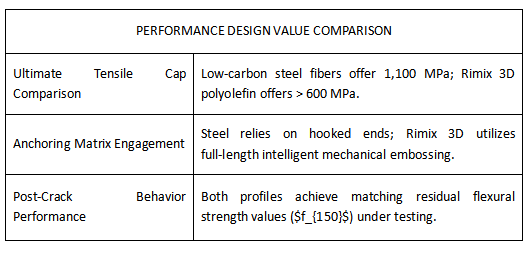

Interlocking Efficiency Metrics
Steel fibers utilize hooked ends to anchor within cured concrete. However, because steel fibers are stiff and heavy, they can settle during placement, leaving sections of the slab with low fiber counts.
Rimix 3D fibers have a specific gravity close to that of the fresh concrete paste, allowing them to remain suspended evenly throughout the matrix. When a micro-crack develops, the higher count of active synthetic fibers compensates for their lower individual tensile strength compared to steel, delivering a matching macro synthetic fiber dosage equivalent to steel in terms of overall load capacity and post-crack toughness.
The Practical Project Benefits of Low-Mass Structural Design
Adopting performance-verified polyolefin substitution ratios yields major operational advantages for construction projects. Managing three kilograms of packaged synthetic material per cubic meter of concrete is significantly faster and safer than moving twenty-five kilograms of rigid steel fiber crates around a jobsite.

Streamlining Global Project Logistics
Consider a large-scale logistics center project requiring $40,000\text{ m}^3$ of structural concrete. Standard steel fiber designs would require shipping, storing, and batching 1,000 metric tons of heavy steel reinforcement.
By utilizing performance-verified Rimix 3D conversions, the project requires only 120 metric tons of macro-synthetic material. This reduction eliminates dozens of heavy freight shipments, simplifies on-site material storage, speeds up batching times, and lowers project carbon emissions, all while maintaining full compliance with global structural safety codes.


Comments