
Engineering Better Concrete with Rimix 3D Synthetic Fiber Reinforcement

In modern concrete design, controlling shrinkage cracks during the early curing stages is one of the most persistent challenges faced by structural engineers and ready-mix producers. As water evaporates from fresh concrete, the resulting capillary negative pressure generates tensile stresses that easily exceed the negligible tensile strength of early-stage cement paste. While traditional welded wire reinforcement (WWR) or steel mesh has long been the default specification, it frequently settles to the bottom of the slab during pouring or fails to intercept cracks where they actually initiate—at the micro-structural level near the surface.
This technical insight explores how Rimix 3D synthetic fiber reinforcement transforms a brittle, unpredictable concrete matrix into a highly resilient, durable structural composite. By introducing a multi-directional structural network directly into the mix, this technology redefines how we manage early-age stress distribution and crack propagation.
The Spatial Mechanics of Rimix 3D Synthetic Fiber Reinforcement
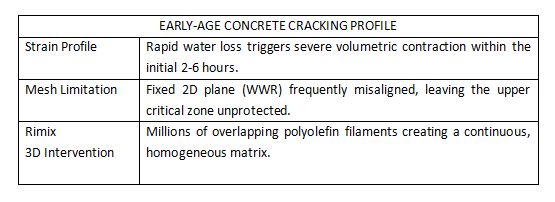
To understand the efficacy of Rimix 3D synthetic fiber reinforcement, one must look beyond two-dimensional structural reinforcement theories. Conventional steel mesh operates strictly on a single, fixed plane. If the mesh is pushed down by foot traffic or heavy machinery during concrete placement, large structural zones are left entirely unprotected against volumetric changes.
In stark contrast, Rimix 3D synthetic fiber reinforcement operates volumetrically. When mixed into the concrete, millions of engineered polyolefin macro-filaments disperse uniformly throughout the entire paste. This omnidirectional arrangement ensures that no matter where an internal tensile stress spike occurs, a high-tensile polyolefin filament is perfectly positioned to intercept it. The fibers act as a spatial network of micro-dowels, redistributing internal strains evenly across three dimensions and mitigating localized stress concentrations before they manifest as visible surface failures.

How the 3D Network Intercepts Micro-Cracks
The primary benefit of this Rimix 3D synthetic fiber reinforcement network lies in its microscopic, proactive action during the critical 2 to 6 hours post-casting—known as the plastic shrinkage window. During this phase, bleeding water channels create vertical planes of weakness.
As the matrix contracts, micro-cracks form around coarse aggregates. The overlapping filaments of Rimix 3D cross these micro-fissures immediately. Because the fibers possess a specialized aspect ratio and modified surface chemistry, they anchor tightly into the hydrating cement gel. This mechanical mechanical bond restrains the separation of the paste, intercepting the micro-cracks at their genesis and preventing them from coalescing into macroscopic structural failures that compromise air permeability and water tightness.

Maximizing Post-Crack Performance and Bond Strength
Once concrete passes its initial curing phase and enters its hardened state, the performance criteria shift from plastic shrinkage control to hardened residual strength. In heavy-duty engineering applications, such as industrial slab-on-ground construction or shotcrete tunnel linings, the concrete must withstand extreme flexural and dynamic structural loading. Under these conditions, the mechanical bond between the reinforcement and the matrix dictates the ultimate failure mode of the structure.
The unique embossed or corrugated surface geometry of Rimix 3D synthetic fiber reinforcement provides exceptional mechanical anchoring with the cement paste. When an external structural load causes the concrete matrix to rupture, the failure mode is fundamentally altered from a catastrophic, sudden brittle failure to a highly controlled, pseudo-plastic deformation process.
Instead of snapping or losing load capacity instantly, the concrete relies on the pull-out resistance of the fibers. As the crack attempts to widen, the deformed surfaces of the polyolefin filaments frictionally engage with the surrounding matrix, absorbing massive amounts of kinetic energy and forcing the crack to distribute its energy across adjacent zones.

Long-Term Crack Width Limitation
Even if an extreme structural overload causes a crack to form in a hardened structure, the embedded Rimix 3D synthetic fiber reinforcement acts as a structural bridge. The high density of macro-fibers crossing the crack plane ensures that tension is continuously transferred back into the uncracked concrete blocks.
By sustaining this post-crack tensile stress, the fibers keep crack widths well below the critical thresholds (<0.3 mm) outlined by standard engineering codes. Maintaining tight crack widths is crucial because it preserves aggregate interlock—the natural ability of the concrete to transfer shear forces across a joint or crack—and prevents the ingress of harmful chemical elements, thus guaranteeing the structural lifespan of the concrete element.


Comments