
Heavy-Duty Upgrades via Macro Synthetic Fiber Reinforcement in Marine Concrete

Updated: Jul 24
Marine environments subject infrastructure to severe chemical attacks, waves, and constant moisture. Implementing heavy-duty upgrades in coastal infrastructure is essential to resist these harsh conditions. By incorporating macro synthetic fiber reinforcement in marine concrete, engineers can eliminate corrosion risks, control crack propagation, and significantly extend the service life of ports and seawalls.
Under these aggressive conditions, conventional steel reinforcement mesh degrades rapidly. Adopting macro synthetic fiber reinforcement in marine concrete using Rimix 3D represents a key paradigm shift, allowing engineers to replace vulnerable steel elements with completely chemical-resistant synthetic composites.


In maritime engineering, the primary cause of premature concrete breakdown is chloride-induced corrosion of steel reinforcement elements. Concrete is inherently porous, and capillary suction easily draws saltwater deep into the structural core. Once chloride ions cross the threshold and reach embedded steel fibers or mesh, they break down the steel's passive protective layer, triggering rapid oxidation.
Because rust expands significantly in volume, it creates immense internal tensile pressures that fracture the concrete from the inside out. Utilizing macro synthetic fiber reinforcement in marine concrete addresses this degradation pathway at the molecular level, as polyolefin filaments are entirely unaffected by salt ions or chemical exposure.
Saltwater Ingress ---> Crosses Concrete Pores ---> Reaches Core
|- Traditional Steel Fiber ----> Rust Expansion ----> Structural Spalling (Failure)
|- Rimix 3D Synthetic Fiber ----> 100% Inert Matrix ----> Longevity Maintained (Success)
Mitigating Tidal Wet-Dry Cycling Strain through Macro Synthetic Fiber Reinforcement in Marine Concrete
Concrete elements located within tidal splash zones face continuous wet-dry cycles that accelerate chemical concentration. As water evaporates from the concrete surface, it leaves behind concentrated salt crystals that exert high crystallization pressures within the material pores.
By utilizing macro synthetic fiber reinforcement in marine concrete, millions of interlocking Rimix 3D filaments create an internal reinforcing matrix. This matrix restrains micro-fissure expansion, keeping the concrete matrix dense and durable even under relentless marine spray.
The mechanical demands placed on port pavement structures are among the highest in civil engineering. Container corner castings concentrate massive static loads onto small footprints, while heavy material handling machinery imposes intense dynamic wheel fatigue across transit lanes.
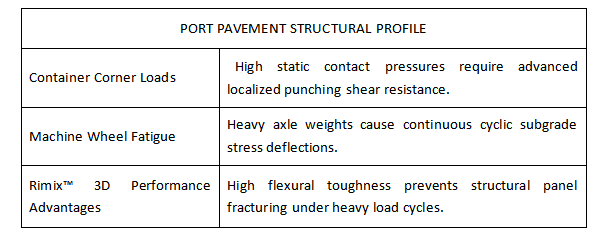

Eliminating Work Interruptions for Port Assets
When a section of a busy container terminal needs maintenance due to broken concrete or rusted rebar mesh, port logistics are significantly disrupted. Closing a container lane creates immediate bottlenecks that delay ship loading schedules and incur heavy demurrage fees.
Specifying macro synthetic fiber reinforcement in marine concrete provides a highly durable pavement solution that requires virtually zero operational maintenance over decades of service. By eliminating rust-driven failures and maintaining excellent post-crack structural integrity, Rimix 3D ensures maritime hubs can operate at maximum throughput without unexpected shutdown expenses.



Comments