
Engineering the Micro-Interface: How Surfactant Coatings Optimize the Polypropylene Fiber Interfacial Transition Zone

In the field of fiber-reinforced concrete material science, a common phrase states that a composite material is only as strong as its weakest link. When evaluating fiber performance, structural engineers often focus on raw material specifications like individual tensile strength or elastic modulus. However, these properties matter only if stress can transfer effectively from the cracked concrete matrix into the reinforcing fiber network.
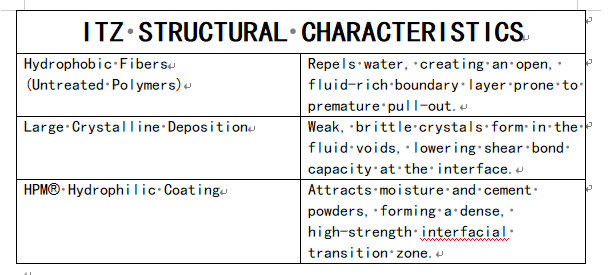
The critical boundary where this stress transfer occurs is known as the Interfacial Transition Zone (ITZ)—a thin layer of cement paste, just a few micrometers thick, that surrounds each embedded fiber filament. Untreated polypropylene is naturally hydrophobic, meaning it repels water and fine cement particles, which can create weak voids around the fiber.
HPM® addresses this boundary issue by engineering the polypropylene fiber interfacial transition zone using advanced hydrophilic surfactant coatings that eliminate weak voids and maximize mechanical bonding.
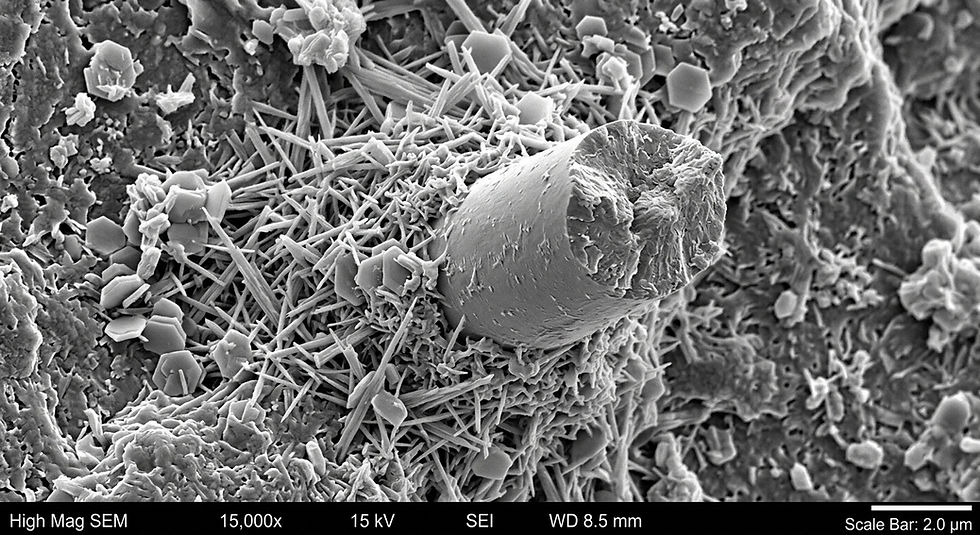
The chemistry of hydrophobic rejection and boundary layer failure in the polypropylene fiber interfacial transition zone
To understand why traditional micro-synthetic fibers sometimes perform poorly in high-performance concrete, we must look at the surface chemistry of untreated polyolefins. Polypropylene features a non-polar carbon chain structure that repels polar water molecules, making the raw fiber surface naturally hydrophobic.
Untreated Hydrophobic Fiber ---> Repels fresh mortar paste ---> Creates thin water film around filament
|- Water Evaporates ----> Leaves open micro-voids along fiber ----> Low Friction Pull-out Failure
|- HPM® Surfactant Coating ----> Attracts cement paste powders ----> Dense Crystal Interlocking Grid
When added to a wet concrete mix, untreated hydrophobic fibers repel the paste, causing a thin film of water to pool around each filament. As the concrete dries and cures, this trapped water leaves behind open micro-voids along the fiber surface.
Instead of forming a dense reinforcing grid, the fibers sit within loose, porous channels surrounded by brittle, large-grain crystals. When stress strikes the concrete element, these loose fibers slide out of their channels prematurely, reducing the overall performance of the structural composite.

Modifying Boundary Chemistry via Advanced Surfactant Coatings
HPM® polypropylene fiber interfacial transition zone engineering eliminates this boundary weakness by permanently applying a specialized surfactant coating during the material extrusion process.

Eliminating Matrix Voids through Material Attraction
The surfactant molecules feature a dual-affinity structure: one end bonds permanently with the polyolefin core, while the outer end presents a highly polar, hydrophilic layer to the wet concrete mix.
This chemical alteration allows the fibers to attract moisture and fine cementitious materials directly to their surface during batching. By drawing the hydrating cement paste tightly against each filament, the coating eliminates water pooling and prevents the formation of weak interfacial voids.
Maximizing Mechanical Anchorage via CSH Gel Integration
As the concrete cures, the chemical attraction provided by the HPM® surfactant coating significantly alters the crystallization behavior within the Interfacial Transition Zone.

Improving Post-Crack Toughness
In unreinforced or poorly bonded concrete matrices, cracks expand quickly because there is little internal resistance to stop them.
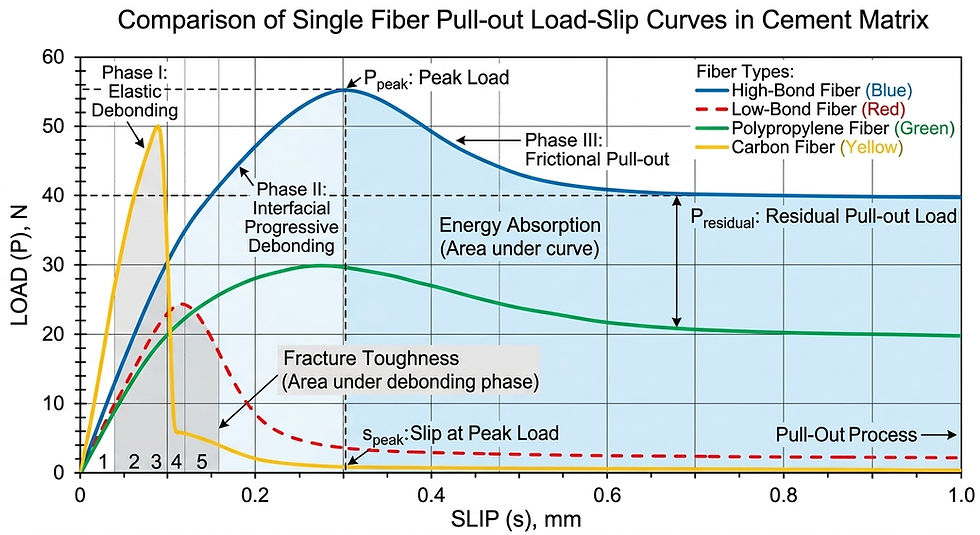
The dense CSH gel matrix achieved by specifying HPM® polypropylene fiber interfacial transition zone configurations ensures exceptional mechanical anchorage. When a micro-crack develops, the tightly bonded fibers absorb and redistribute the horizontal tensile stresses into the surrounding uncracked paste, controlling crack widths and improving the long-term durability of the concrete structure.


Comments