
Maximizing Interlocking Mechanics via Macro Synthetic Fiber Pull Out Resistance

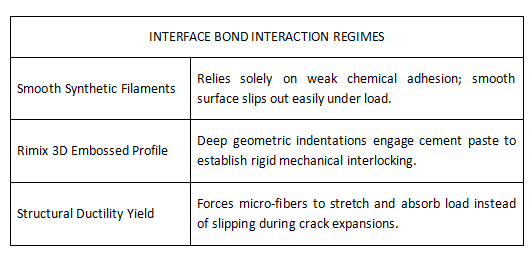
When analyzing how fiber networks reinforce concrete, material scientists look beyond the raw tensile capability of the isolated polymer strand. The true limiting factor in fiber-reinforced concrete (FRC) efficiency is interfacial bond strength—the quality of the physical connection between the embedded fiber filament and the surrounding hardened cement paste. If a fiber possesses a smooth surface finish, it will slip out of the concrete matrix when structural cracks develop, failing to transfer tensile loads effectively.Optimizing macro synthetic fiber pull out resistance is essential for ensuring long-term crack bridging.
Maximizing macro synthetic fiber pull out resistance is critical to unlocking the full potential of composite materials. Rimix 3D utilizes an advanced, computer-controlled mechanical embossing process during manufacturing to impart a deep, geometric texture to each fiber filament, establishing an exceptional physical anchor within the concrete matrix.

To understand how a textured surface improves performance, it is helpful to analyze the mechanics of a single fiber crossing a concrete crack plane as a tensile load is applied. This pull-out interaction progresses through three distinct mechanical phases.To understand how a textured surface improves performance, it is helpful to analyze the mechanics of a single fiber crossing a concrete crack plane as a tensile load is applied. This pull-out interaction progresses through three distinct mechanical phases.
Phase 1: Chemical Adhesion (Initial Grip) ---> Phase 2: Geometric Interlocking (Embossing Anchors Engaged) ---> Phase 3: Friction Sliding (Energy Dissipation)
Phase 1: Chemical Adhesion – This represents the native bond between the polymer surface and the cement hydration paste. While necessary, chemical adhesion is brittle and breaks down under minimal displacement.
Phase 2: Geometric Interlocking – This is where Rimix 3D's unique design excels. As the chemical bond yields, the concrete paste cast into the fiber's surface indentations resists movement. This mechanical lock forces the fiber to resist slipping, engaging its full tensile strength to manage the crack.
Phase 3: Frictional Sliding – As the fiber slowly draws out under extreme loading, the embossed profile continues to plow through the concrete channels, creating sustained frictional resistance that absorbs large amounts of structural energy.
Imparting an embossed texture requires careful engineering balance. If the embossing rollers press too deeply into the hot polymer filament, they can thin the core cross-sectional area, creating localized weak points that lower the fiber's overall tensile strength.


Optimizing Macro Synthetic Fiber Pull Out Resistance and Energy Absorption
This combination of high individual tensile capacity and excellent anchorage design directly improves the fiber-reinforced concrete's overall toughness metrics. Slabs reinforced with Rimix 3D display stable, reliable load-transfer performance after cracking occurs.
Instead of experiencing sudden, unexpected panel failures due to fiber slippage, the slab handles structural overloads safely. The micro-fibers hold the concrete segments together tightly, maintaining uniform load distribution across industrial floors and heavy-duty external pavements over decades of challenging service.


Comments