
Micro Synthetic Fibers vs Wire Mesh—Which Is Better?

Updated: Aug 19
Suitable for architectural engineers, structural engineers, flooring contractors, precast component manufacturers, and technicians.
Micro synthetic fibers and welded wire mesh (WWM) are two common reinforcement systems used in concrete slabs, industrial floors, pavements, precast elements, and overlays. While WWM has long been the traditional choice for temperature and shrinkage control, micro synthetic fibers—especially monofilament polypropylene fibers—offer major advantages in early-age cracking control, labor efficiency, and overall durability.
This article compares micro synthetic fibers to wire mesh in crack control, installation efficiency, surface finish, curling performance, and industrial flooring applications.

How Each Reinforcement Performs in Crack Control
Plastic Shrinkage Control
Micro synthetic fibers outperform wire mesh in the first 2–12 hours, when plastic shrinkage cracks form due to rapid evaporation, wind, high temperature, or low humidity.
Micro Fibers:
Distributed throughout the concrete (3D reinforcement)
Act immediately during early hydration
Reduce plastic shrinkage cracks by 70–90% (ASTM C1579)
Wire Mesh:
Located only at mid-depth or lower (often placed incorrectly)
Does not prevent plastic shrinkage cracking
Only becomes active after cracks widen
➡ Winner: Micro synthetic fibers
Structural Cracks
Wire mesh provides structural crack distribution only when properly positioned, which is uncommon in real field conditions.
Micro synthetic fibers:
Control crack initiation
Reduce crack width growth
Improve micro-crack distribution
Enhance durability by reducing water and chloride penetration
Wire mesh:
Effective only if chairs are used and mesh stays fully elevated
Often ends up at the bottom → little reinforcement benefit
Does not prevent cracks—only limits their width
➡ Winner: Draw (depends on structural requirement), but fibers provide more consistent results
Labor & Installation Differences
Placement Time
Wire mesh placement is labor-intensive:
Cutting, tying, lifting, and maintaining chair height
Requires large labor crews
Slows down production rate
Trip hazards on site
Micro synthetic fibers:
Added directly into the mixer
No placement, tying, or positioning
No labor risk
Perfect reinforcement distribution without extra work
➡ Winner: Micro synthetic fibers

Cost Comparison
Wire Mesh Costs Include:
Material cost
Cutting, tying, and labor
Concrete rework due to improper placement
Delays in pour schedule
Micro Synthetic Fiber Costs Include:
Only material cost
Lower labor cost
Faster production
Lower rework risk
No rusting or long-term corrosion repair
➡ Winner: Micro synthetic fibers (lower total cost)
Performance in Industrial Flooring
Surface Finish
Micro fibers:
Do not affect finishing when dosage is ≤1.0–1.2 kg/m³
Ensure smooth surface with minimal hairline visibility
Wire mesh:
No impact on surface finish
But cracks often reflect through slab surface when mesh is misplaced
➡ Winner: Micro fibers (better crack distribution, smoother long-term surface)
Risk of Curling
Micro fibers:
Reduce moisture loss differential
Minimize warping during drying
Improve slab stability
Wire mesh:
Does not influence shrinkage distribution
Does not reduce curling
Mesh placement errors worsen curling at edges
➡ Winner: Micro synthetic fibers
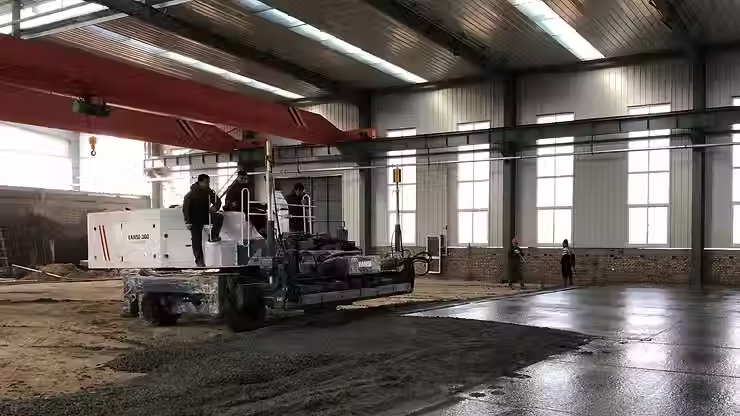
When Micro Synthetic Fibers Are the Superior Choice
Early-Age Cracking
Micro fibers are ideal when:
High temperature / low humidity
Windy outdoor pours
Large surface area slabs
Fast-setting or low-slump mixes
Industrial floors with heavy equipment
➡ Micro fibers prevent early-age cracking in ways mesh cannot.
Large Slab Pours
Micro fibers are especially effective for:
Big-box warehouses
Logistics centers
Superflat floors
Pavements
Runways & aprons
Long strip pours
Wire mesh slows construction and increases risk of placement errors, while micro fibers:
Maintain consistency
Improve production rate
Reduce joints
Reduce curling
➡ Micro synthetic fibers deliver superior performance and efficiency in large-scale placements.
Conclusion
Micro synthetic fibers provide:
Better early-age crack control
Lower labor cost
Faster construction
Improved long-term durability
Better crack width distribution
Reduced curling
Wire mesh still has use in structural reinforcement, but for temperature, shrinkage, crack control, and industrial floors, micro synthetic fibers are the superior choice.
Explore PIONEER’s range of concrete reinforcement fibers and how they improve concrete properties. Visit our website: www.pioneerfibre.com
Micro fiber >> Learn More
Macro fiber >> Learn More
Steel fiber >> Learn More
Asphalt fiber >> Learn More
Looking for a tailored fiber or concrete reinforcement solution?
Our technical team supports mix design optimization, material selection,
and project-specific recommendations worldwide.


Comments