
The Future of Alkali-Resistant Fibers in Tunnels and Bridges

Updated: Aug 24
Abstract
As infrastructure demands grow, so does the need for durable, corrosion-resistant materials. This article explores how alkali-resistant fibers are becoming essential in tunnel linings and bridge construction, offering superior performance under extreme conditions while extending service life and reducing maintenance costs.
Contact us for samples, consultations, and tailored solutions. [Contact us]
Introduction: Why Alkali-Resistant Fibers Are Critical for Infrastructure
Tunnels and bridges face some of the harshest environmental conditions—moisture exposure, chemical infiltration, freeze-thaw cycles, and high mechanical stress. Traditional steel reinforcement is prone to corrosion in these settings, leading to costly repairs and safety concerns.
Enter alkali-resistant (AR) fibers, particularly those made from glass with high zirconia content. These fibers offer a non-corrosive, lightweight alternative that enhances concrete’s flexural strength, crack resistance, and long-term durability.
In recent years, engineers and contractors have increasingly turned to alkali-resistant fibers in tunnels and bridges as part of a broader shift toward sustainable, low-maintenance infrastructure solutions.
This article examines current applications, performance benefits, and future trends shaping the role of AR fibers in critical civil engineering projects.
The Role of Alkali-Resistant Fibers in Tunnels and Bridges
One of the primary functions of alkali-resistant fibers is to reinforce sprayed concrete (shotcrete) and precast elements used in:
Tunnel linings
Bridge decks and overlays
Retaining walls and abutments
Drainage structures
These fibers act as secondary reinforcement, helping to control micro-cracking caused by shrinkage, thermal movement, and mechanical loading. Unlike steel, they do not rust—even when exposed to moisture or chlorides—making them ideal for environments where corrosion is a major concern.
Key Advantages of AR Fibers in Infrastructure Projects:
Corrosion resistance: Eliminates risk of rebar degradation in aggressive environments.
Improved impact and fatigue resistance: Enhances structural integrity under repeated load cycles.
Crack control: Limits crack propagation, improving waterproofing and longevity.
Lightweight and easy to integrate: Can be added directly into concrete mix without complex installation.
Cost-effective lifecycle performance: Reduces long-term maintenance and repair expenses.

See how we’ve helped projects around the world succeed. [View projects]
How AR Fibers Improve Tunnel Safety and Performance
In tunnels, especially those used for road or rail transport, fire safety is a top priority. Concrete spalling during fires can pose serious risks to structural stability and occupant safety.
Studies show that incorporating alkali-resistant fibers into tunnel shotcrete significantly reduces explosive spalling during high-temperature events. The fibers act as pressure release channels, allowing steam to escape rather than build up within the concrete matrix.
Additionally, AR fiber-reinforced tunnel linings maintain their integrity over time, even under continuous water exposure and chemical attack—key factors in underground environments where maintenance access is limited.
Real-World Applications of Alkali-Resistant Fibers in Bridge Construction
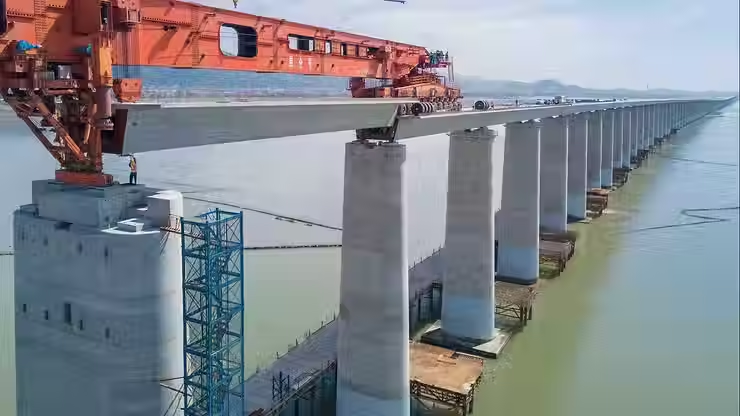
Bridges—especially those in coastal areas or subject to deicing salts—face constant exposure to corrosive agents. Steel rebars embedded in concrete often degrade prematurely, leading to cracking, spalling, and costly rehabilitation efforts.
By contrast, alkali-resistant fibers provide distributed reinforcement that:
Resists chloride ingress
Minimizes surface cracking
Enhances durability under cyclic loading
Extends design life beyond 50–100 years
Several high-profile bridge projects have successfully implemented AR fiber technology, including:
The Second Avenue Subway, New York City: Used fiber-reinforced shotcrete for station linings to improve fire resistance and reduce maintenance.
The Øresund Bridge, Denmark-Sweden: Incorporated AR fibers in deck overlays to resist saltwater corrosion and extend service intervals.
Changi Airport Tunnel, Singapore: Utilized fiber-reinforced concrete to enhance durability in a humid, chemically active environment.
These case studies underscore the growing reliance on alkali-resistant fibers in tunnels and bridges for both new builds and retrofitting existing structures.
Find the perfect solution for your concrete project. [Explore solutions]
Integration with Smart Infrastructure Systems
As infrastructure becomes more intelligent, the use of alkali-resistant fibers is expanding beyond basic reinforcement. Researchers are exploring ways to embed sensors and monitoring systems within fiber-reinforced concrete to enable real-time health assessments.
Fiber-optic sensing combined with AR fiber composites could allow engineers to detect early signs of damage, temperature changes, or moisture intrusion—enabling predictive maintenance and minimizing downtime.
This integration represents a promising frontier for alkali-resistant fiber technology in next-generation transportation infrastructure.
Final Thoughts: Building Smarter with Alkali-Resistant Fibers
The increasing adoption of alkali-resistant fibers in tunnels and bridges reflects a broader industry shift toward resilient, sustainable infrastructure. As climate change intensifies weather extremes and corrosion challenges, the need for durable, low-maintenance materials has never been greater.
At Pioneer Fibre, we specialize in high-performance alkali-resistant glass fibers engineered for infrastructure applications. Our products deliver proven results in demanding environments—helping engineers meet modern standards for safety, longevity, and cost efficiency.
Whether you're designing a new tunnel system or rehabilitating an aging bridge, integrating AR fibers into your concrete mix can make a measurable difference in performance and sustainability.
Explore PIONEER’s range of concrete reinforcement fibers and how they improve concrete properties. Visit our website: www.pioneerfibre.com
Micro fiber >> Learn More
Macro fiber >> Learn More
Steel fiber >> Learn More
Asphalt fiber >> Learn More
Looking for a tailored fiber or concrete reinforcement solution?
Our technical team supports mix design optimization, material selection,
and project-specific recommendations worldwide.


Comments