
High-Performance Fiber Test Data: How to Review the Evidence

Updated: 5 days ago
High-Performance Fiber Test Data can support material selection only when it answers the project’s actual question. A fiber datasheet, a research paper, and a test report serve different purposes. Treating them as interchangeable can create unsupported design or marketing conclusions.
What High-Performance Fiber Test Data Should Identify
Begin with traceability. The report should identify the product or grade, fiber material and geometry, dosage and units, concrete or mortar proportions, fresh properties, specimen dimensions, curing, test age, equipment, method, number of specimens, results, and variability. The laboratory, report date, and report number should also be visible when formal verification is required.
Check whether the tested mixture resembles the proposed mixture. Changes in binder composition, water-to-binder ratio, aggregate, admixtures, fiber dosage, mixing, curing, or specimen geometry may limit direct use of the result. The Data Sheets center can establish product identity, but a TDS alone does not demonstrate composite performance.
Separate Fiber Properties from Concrete Performance
Fiber tensile strength, modulus, elongation, density, and melting behavior are material properties. They do not independently establish crack reduction, toughness, residual strength, structural capacity, durability, conductivity, or fire resistance in concrete.
Composite claims require an appropriate concrete or mortar test. ASTM C1609, for example, measures flexural performance using a defined beam procedure; it should not be cited as proof of every application or durability outcome. A fire-spalling evaluation requires a method, specimen, conditioning, heating exposure, loading condition, and acceptance basis suited to that risk.
Decide Whether the Evidence Is Transferable
Use the High-Performance Fibers selection guide to confirm that the report concerns the correct fiber family. Then compare test conditions with the project specification. Note every mismatch and determine whether a project trial, additional laboratory program, or engineering adjustment is required.
The High-Performance Fibers category can route users to the relevant product documentation. Acceptance should still be defined by the responsible project parties.
Check the Claim Against the Report
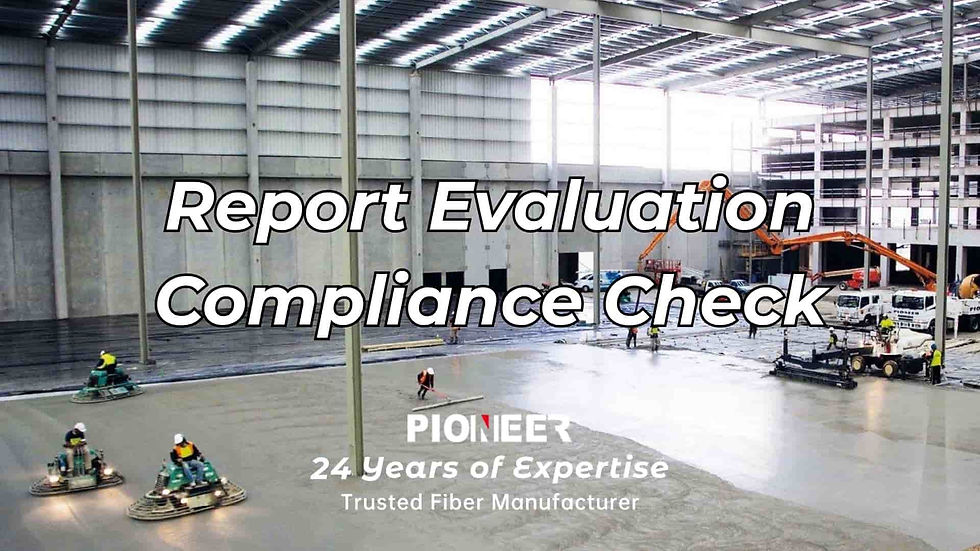
Before publishing or specifying a result, write the proposed claim beside the exact report section that supports it. Confirm that units, averages, ages, reference mixture, and uncertainty have not been omitted. If a conclusion depends on interpretation rather than an explicit result, label it as an inference. When essential information is missing, request the complete report or describe the evidence gap instead of filling it with assumptions.
Technical References
ASTM C1116/C1116M, fiber-reinforced concrete specification
ASTM C1609/C1609M, flexural performance of fiber-reinforced concrete
ACI 544.2R, fresh-state properties and fiber dispersion
Technical Verification Statement
This article does not validate any unpublished Pioneer Fibre result. Product values, dosage, report numbers, certifications, and performance claims must be copied only from current controlled documents and checked against the proposed project conditions.


Comments