
Monofilament Macro Fibers: What to Evaluate in Concrete

Updated: 2 days ago
Monofilament macro fibers are individual engineered polymer filaments intended for distribution through concrete. After cracking, a qualified product may bridge cracks and contribute to toughness or residual load transfer. The measured result belongs to the tested fiber–concrete system, not to the fiber geometry alone.
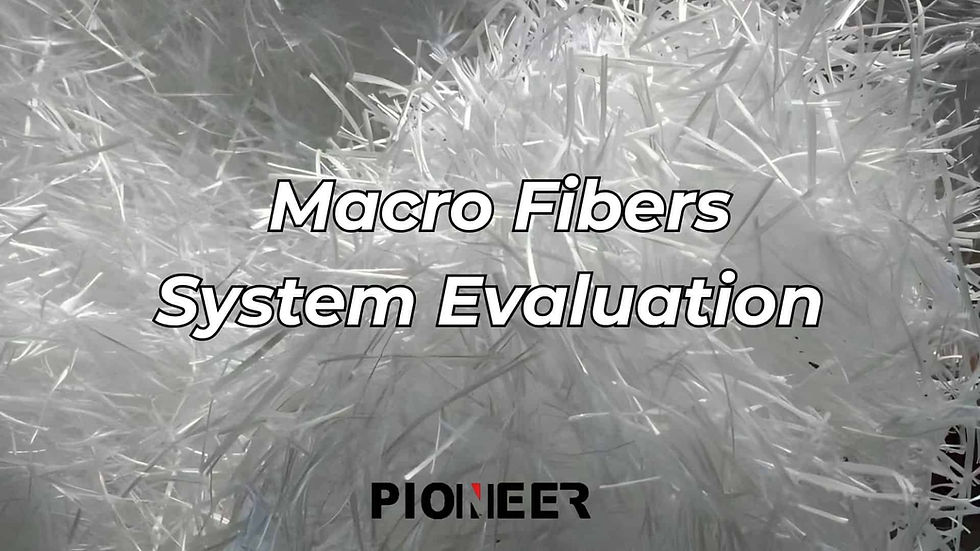
How Monofilament Macro Fibers Work
Fiber length, cross-section, surface characteristics, orientation and bond behavior influence how individual filaments intersect and bridge cracks. Dosage, concrete composition, mixing, consolidation, curing and test method also affect performance.
Review HTM Mono when a monofilament product is being evaluated for a specific project.
Selection and Trial Questions
Define the application, loading, exposure, placing method, finish and required post-crack criterion. Request the current product documents and relevant concrete test reports. A representative trial should record dosing, dispersion, workability, pumping where applicable, placing, consolidation and finish.
Use the Macro Synthetic Fibers category page to compare monofilament geometry with twisted, embossed and blended alternatives. For report interpretation, read Macro Synthetic Fiber Test Reports.
Monofilament macro fibers should not be described as automatically improving durability or replacing conventional reinforcement. Any substitution must be supported by product-specific evidence, the governing design method and approval by the responsible engineer.
Technical References: ASTM C1116/C1116M-23; ASTM C1609/C1609M-24; ACI 544.4R-18.
Technical Verification Statement: Verify the exact HTM Mono grade, dosage, concrete, test method, report and approved design role before publishing performance claims.


Comments