


PNE® GS-6060
Glued End-Hooked Steel Fibers
High-Tensile Steel Fibers for Concrete
Since 2002, we have specialized in concrete crack resistance, waterproofing, and anti-corrosion technologies.
Glued-End Hooked Steel Fibres for SFRC | PIONEER®
High-Strength Steel Fibre Reinforcement for Durable Concrete
What Are Glued-End Hooked Steel Fibres in Fiber Reinforced Concrete?
PNE® GS-6060 glued end-hooked steel fibres are high-tensile, cold-drawn steel fibers bonded into low-clump glued bundles, ensuring easy feeding and uniform mixing.
The hooked-end anchorage provides superior pull-out resistance, forming a 3D reinforcement network inside concrete.
These steel fibers can be used as an alternative to welded wire mesh in selected applications, subject to project-specific design and performance requirements.
-
industrial flooring
-
tunnel shotcrete
-
precast concrete elements
-
high-strength concrete
-
warehouse slabs & pavements
This configuration aligns with global SFRC practices and improves crack width control, durability, and load transfer.
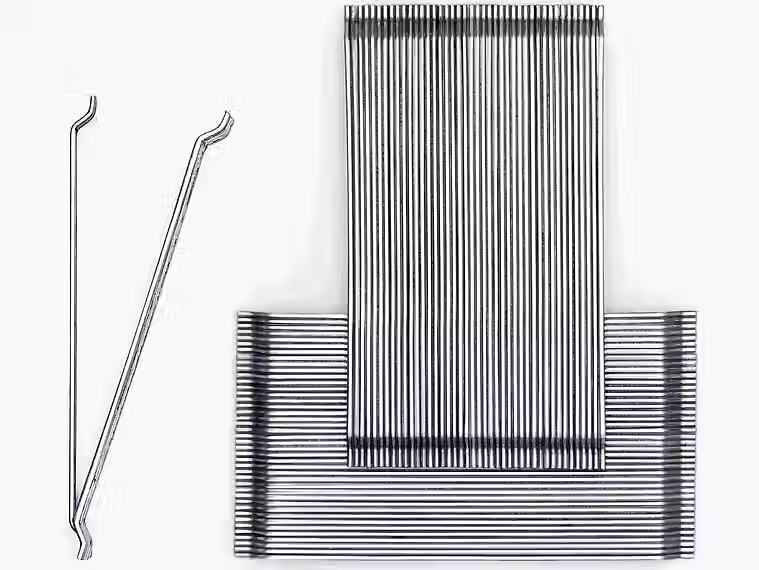
Technical Specifications of Glued-End Hooked Steel Fibres for SFRC
Detailed steel fiber specifications to support your fibre reinforced concrete projects:
-
Material: High-tensile steel
-
Type: Glued end-hooked steel fibre
-
Specific Gravity: 7.8 g/cm³
-
Diameter: 0.9 mm
-
Length: 60 mm
-
Aspect Ratio: 67
-
Tensile Strength: 1000–1360 MPa
-
Modulus of Elasticity: 200 GPa
-
Color: Metallic gray
Applicable standards and test methods
PIONEER® steel fibers are developed with reference to internationally recognized standards for steel fiber products and fiber-reinforced concrete. Applicable standards and documentation depend on the product grade, intended application, project requirements, and destination market.
-
ASTM A820/A820M — Standard Specification for Steel Fibers for Fiber-Reinforced Concrete
-
ASTM C1116/C1116M — Standard Specification for Fiber-Reinforced Concrete
-
EN 14889-1:2006 — Fibres for Concrete — Part 1: Steel Fibres — Definitions, Specifications and Conformity
These standards provide technical references for steel fiber selection and use in precast concrete, industrial floors, shotcrete, and other fiber-reinforced concrete applications. Product suitability should be confirmed according to the project design, required performance, and applicable local regulations.
Benefits of Glued-End Hooked Steel Fibres in Concrete
Key advantages for crack control, durability, and reinforcement efficiency:
-
Superior crack control & load transfer efficiency
-
High mechanical anchorage with robust hooked ends
-
Anti-clumping glued bundles ensure uniform dispersion
-
Cleaner, dust-free handling & consistent workability
-
Reduces reliance on welded wire mesh, lowering cost
-
Enhances impact & fatigue resistance in heavy-duty concrete
-
Ideal for industrial warehouse flooring, pavements, and UHPC

Improves strength and crack resistance

Enhances durability and flexural performance
Applications of Glued-End Hooked Steel Fibres in Concrete
Versatile uses across high-performance fiber reinforced concrete:
-
Industrial floors & heavy-duty slabs-on-ground
-
Shotcrete for tunnels / mining / slope protection
-
Precast concrete pipes, panels & tunnel segments
-
Pavements, bridge decks & composite steel decks
-
UHPC & high-strength structural concrete
-
Airport pavements & metro tunnel linings

Hong Kong-Zhuhai-Macao Bridge

Da Nang Pier, Vietnam

Hangzhou Olympic Center
Usage Guidelines for Steel Fibre Reinforced Concrete
Best practices for steel fiber dosage and mixing:
-
Dosage: 15–45 kg/m³ depending on performance requirements
-
Mixing: Add fibers after aggregates to improve uniform dispersion
-
Blend 3–5 minutes until bundles fully separate
-
Compatible with all standard finishing methods
-
Can partially replace rebar/mesh per engineering design
Custom Solutions for Glued-End Hooked Steel Fibres
Flexible packaging tailored for concrete plants and distributors:
-
20 kg/bag or customied
-
Bulk steel fiber packaging for large projects
-
OEM/ODM & private label service for global suppliers
Is Steel Fiber Still the Best Choice for Your Project?
Steel fiber is widely used in steel fiber reinforced concrete, offering high strength and reliable structural reinforcement in slabs and industrial floors.
However, in real construction, its performance often depends heavily on mixing and placement. Issues such as fiber balling, uneven distribution, surface exposure, and potential corrosion can affect workability, finishing quality, and long-term durability.
Where Steel Fiber Can Slow Down Your Project
On site, steel fiber can increase handling effort, affect pumpability, and lead to inconsistent reinforcement if not properly dispersed.
Exposed fibers may also interfere with finishing, making it harder to achieve a smooth and uniform surface.

A More Efficient Alternative for Modern Concrete
Rimix™ 3D macro synthetic fiber provides a more consistent reinforcement approach with easier mixing, uniform dispersion, and better finishing performance.
No corrosion risk. No surface exposure. Easier placement.
It helps improve construction efficiency while delivering stable, long-term concrete performance.


Looking for a Quote or More Information about Our Products?
Share your application and receive the best fiber recommendation.
Select your application to get a faster recommendation
Privacy Assurance: We respect your privacy and will never share your information.
Why Choose Us?
Proven Expertise & Greater Savings
24 years of focus
on fiber reinforcement solutions.
5,000 tons yearly
from advanced manufacturing.
20+ countries served
with global product distribution.
1,000 projects proven
in diverse applications worldwide.
Why Choose PIONEER® Technologies
Certified Technical Data
Access product-specific datasheets, lab testing reports, and international compliance certificates for seamless project approval.
Proven Global Experience
Trusted worldwide for high-performance concrete fiber reinforcement across industrial, commercial, and infrastructure projects.
Broad Micro Fiber Range
Complete micro synthetic fiber portfolio—including monofilament, fibrillated, ultra-fine, self-dispersing, and polyester fibers for shrinkage crack control.
Expert Dosage & Engineering Support
Get tailored product selection, precise dosage optimization, and technical submittal assistance from our concrete specialists.

26,500m² production base

Advanced fiber dispersibility

Exceptional tensile strength
FAQ
PNE® GS-6060 is a glued end-hooked steel fiber for fiber-reinforced concrete. It combines a bonded-bundle supply format with hooked-end steel fiber geometry for applications where fiber distribution and post-crack performance are part of the project requirements.
The glued bundle is designed to support controlled handling and batching. During mixing, the bundles separate so that individual steel fibers can disperse through the concrete. Actual dispersion depends on the concrete mix, dosage, batching sequence and mixing conditions.
GS-6060 is supplied as glued bundles, while a loose hooked-end product such as PNE® ES-6660 is supplied as individual fibers. Both use hooked-end geometry, but their handling, batching and product specifications differ.
Final dosage should be selected according to the current PNE® GS-6060 TDS, concrete application, required performance, applicable test method and project specification. Do not select dosage based on a generic steel fiber value alone.
It may be considered in selected applications where project design, performance testing and applicable approvals support substitution or reduction of conventional reinforcement. It should not be treated as a universal replacement.